ACD/Name (Chemist Version) offers a standardized set of features for quick and simple generation of IUPAC names, and structures from names. It is a streamlined version of our popular ACD/Name software.
View a full description and pricing on our web store.
 and
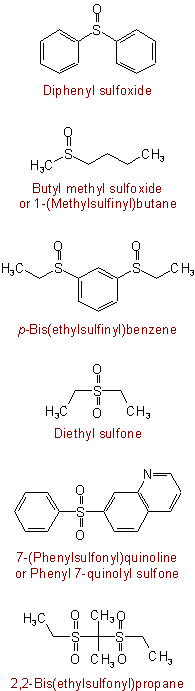
and  are named "sulfoxides" and "sulfones", respectively. Specific names are formed by
placing the names of the radicals
are named "sulfoxides" and "sulfones", respectively. Specific names are formed by
placing the names of the radicals  and
and  (in alphabetical order) before "sulfoxide" or "sulfone". Alternatively compounds
  and
and  may be
named from the radical R1 followed by "sulfinyl-" or "-sulfonyl-" and the name of the parent compound corresponding to , where is senior to .
may be
named from the radical R1 followed by "sulfinyl-" or "-sulfonyl-" and the name of the parent compound corresponding to , where is senior to .
Note: In the latter type of nomenclature the groups  and
and  are named as acyl radicals substituted into a molecule
 , and thus names of the type phenylsulfonyl, phenylsulfinyl, etc., are used. However, in radicofunctional nomenclature names of the type benzenesulfonyl, benzenesulfinyl,
etc., are used (see Rule C-641.7; and compare Rule C-543.3). This difference parallels that for cyclohexanecarbonyl and cyclohexylcarbonyl (see Note to Rule
C-403.2) and it applies also to derived radicals such as benzenesulfonimidoyl or phenylsulfonimidoyl, etc. (Rule C-642.4).
, and thus names of the type phenylsulfonyl, phenylsulfinyl, etc., are used. However, in radicofunctional nomenclature names of the type benzenesulfonyl, benzenesulfinyl,
etc., are used (see Rule C-641.7; and compare Rule C-543.3). This difference parallels that for cyclohexanecarbonyl and cyclohexylcarbonyl (see Note to Rule
C-403.2) and it applies also to derived radicals such as benzenesulfonimidoyl or phenylsulfonimidoyl, etc. (Rule C-642.4).
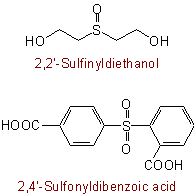
631.2 - The prefixes "sulfinyl-" and "sulfonyl-" are used for the bivalent groups >SO and >SO2, respectively, in conjunction with the nomenclature of assemblies of identical units (see Subsection C-0.7), when substituents are also present that have priority over these groups for citation as principal group.Examples to Rule C-631.1
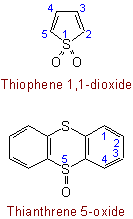
631.3 - When an >SO or >SO2 group is incorporated in a ring the compound is named as an oxide.Examples to Rule C-631.2
See Recommendations'93 R-5.5.7Examples to Rule C-631.3


Published with permission of the IUPAC by Advanced Chemistry Development, Inc., www.acdlabs.com, +1(416)368-3435 tel, +1(416)368-5596 fax. For comments or suggestions please contact [email protected]