ACD/Name (Chemist Version) offers a standardized set of features for quick and simple generation of IUPAC names, and structures from names. It is a streamlined version of our popular ACD/Name software.
View a full description and pricing on our web store.
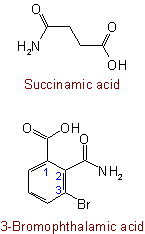
The following names are also recommended:Examples to Rule C-431.1
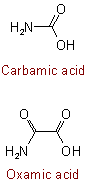
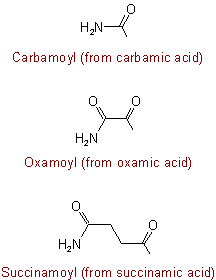
431.2 - Acyl radicals derived from the above amic acids are named by replacing the "-amic acid" ending by "-amoyl''.
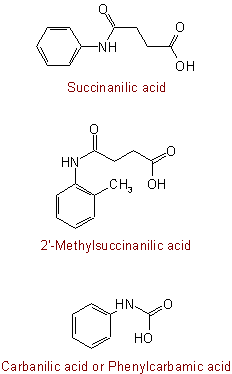
431.3 - When the corresponding dicarboxylic acid has a trivial or semitrivial name, N-phenyl derivatives of-amic acids are named by changing the ending "-amic acid'' to "-anilic acid''.Examples to Rule C-431.2
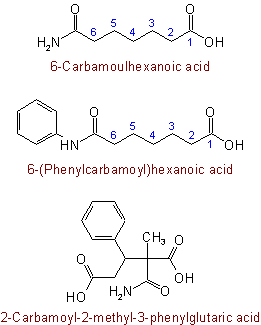
431.4 - Ionoamides of dicarboxylic acids without trivial names and the mono- or di-amides of tricarboxylic acids, etc., are designated as carbamoyl derivatives of the acid named on the basis of the remaining carboxyl groups.Examples to Rule C-431.3
(This Rule is partly alternative to Rule C-431.1.)
See Recommendations'93 R-5.7.1Examples to Rule C-431.4


Published with permission of the IUPAC by Advanced Chemistry Development, Inc., www.acdlabs.com, +1(416)368-3435 tel, +1(416)368-5596 fax. For comments or suggestions please contact [email protected]