ACD/Name (Chemist Version) offers a standardized set of features for quick and simple generation of IUPAC names, and structures from names. It is a streamlined version of our popular ACD/Name software.
View a full description and pricing on our web store.
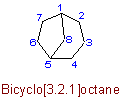
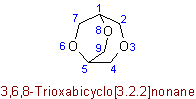
 ) is given by arabic numbers cited in descending numerical order separated by full stops and enclosed in square brackets.
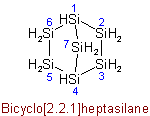
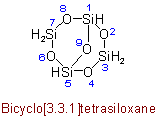
The system is numbered starting with one of the bridgeheads and proceeding through the longest bridge to the second bridgehead, continuing back to the first bridgehead by means of the longer unnumbered bridge; these two bridges constitute the 'main ring' of the system. Numbering is completed by numbering the remaining bridge (the shortest) beginning with the atom next to the first bridgehead.
This method has also been used for bicyclic systems of alternating skeletal atoms.Examples to R-2.4.2.1
R-2.4.2.2 Polycyclic ring systemsExamples to R-2.4.2.1
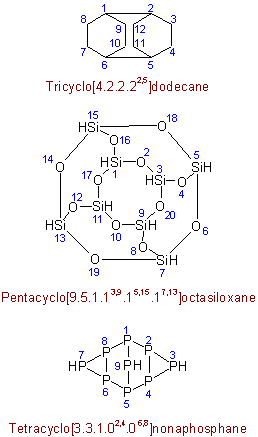
. Polycyclic analogues of saturated bicyclic ring systems (see R-2.4.2.1) are named
by using the prefixes 'tricyclo-', 'tetracyclo-', etc., in place of 'bicyclo-'. The number of atoms in the additional bridges (called 'secondary bridges') is indicated by arabic numbers separated by
full stops and cited, in decreasing numerical order, following those describing the largest bicyclic system. The location of each secondary bridge is indicated by the arabic number locants of the
structure already numbered, which are cited as superscripts to the arabic number denoting its length and separated by a comma. When there are secondary bridges of equal length, they are cited in
order of the increasing value of their lower-numbered bridgehead atom. The secondary bridges are numbered in decreasing order of size. Numbering of each bridge follows from the bridgehead already
numbered proceeding from its higher numbered end. If bridges of equal lengths are present, numbering begins with the bridge having the highest numbered bridgehead atom.
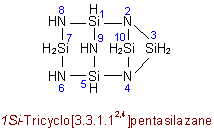
Prefixes such as 1Si- and 1N- are used in polycyclic systems of alternating skeletal atoms when it is necessary to indicate the atom at the bridgehead that is to have the locant '1'.Examples to R-2.4.2.2
Examples to R-2.4.2.2


Published with permission of the IUPAC by Advanced Chemistry Development, Inc., www.acdlabs.com, +1(416)368-3435 tel, +1(416)368-5596 fax. For comments or suggestions please contact [email protected]