

For NMR-based structure verification workflows to be truly high-throughput, analysis must be automated, as manual interpretation creates a significant bottleneck. In these settings, an automated structure verification (ASV) system must deliver fast, reliable results from minimal spectral data to conserve instrument time and avoid shifting the bottleneck to acquisition.
In these two case studies, scientists at Syngenta and Amgen demonstrate how Automated Structure Verification (ASV), powered by NMR Workbook Suite™, enables scalable, consistent, and efficient structure verification in high-throughput quality control workflows.
Explore their process from optimizing dataset selection to reducing analysis time, improving data confidence, and accelerating decision-making with ASV.
Automated Structure Verification at Syngenta
Katharina is one of three NMR scientists on the NMR team that is part of Syngenta Chemistry Research at Syngenta Crop Protection R&D in Stein. The team mainly works to support their synthesis colleagues in structure elucidation and verification among many other duties, even beyond NMR.

Katharina Gaus
Analytical Scientist
NMR Team Responsibilities
- NMR structure elucidation & verification
- Special NMR experiments
- High-throughput NMR (HTNMR)
- Reaction kinetics by NMR
- Byproduct analysis by NMR
Open Access NMR
- 3×400 MHz instruments
- ~50,000 samples/year
- >100 users
Expert Equipment
- 2×600 MHz instruments
- HTNMR capabilities
- 1H, 13C, 19F
For scientists at Syngenta, quality control (QC) is important—even in a research environment. For example, their chemical store contains materials of different ages and from various sources. Performing periodic quality control allows research scientists to confidently use the materials they obtain from the store in their experiments. Similarly, when something is synthesized, it is important to ensure the quality before it is used in further experiments/decisions. Finally, they also perform quality control for exchanging materials in collaborative projects—ensuring the quality of what they are sending out and receiving.
In all these cases, ensuring quality comes down to correctly verifying the chemical structure. To minimize the time they have to spend verifying known structures, Katharina and her colleagues rely on automated structure verification (ASV) with NMR Workbook Suite™.
Selecting NMR Experiments for ASV
The first step in implementing a QC NMR workflow with ASV was to identify the dataset that would give them optimal accuracy without compromising efficiency. Estimating that they have approx. 20,000 samples that could be used with ASV in a year, Katharina and her team calculated the time it would take to measure the datasets. (Table 1)
Table 1. Approximate time required to acquire various NMR datasets.
| Dataset | Time per Sample (including tune, shim, etc.) [min] | Days of 24/7 Measurement Time per Year | Comments |
| 1H | 4 | 56 | ~1 day/week |
| 1H + HSQC on cryoprobe | 7 (with decent concentration) | 97 | Highly dependent on sample availability |
| 1H + HSQC on RT probe (400 MHz)HH | 25 | 347 | Not realistic, but may still be useful for individual cases |
| 1H + COSY + HSQC + HMBC + 13C + 19F on cryoprobe | Maybe 40 (with decent concentration) | 556 | Impossible |
Knowing that it would be impossible to measure the complete dataset for all their samples, they next aimed to identify a smaller dataset that could provide comparable accuracy in ASV. To do this, they measured the complete dataset for two different batches of 96 samples each. They then went back and selectively excluded certain experiments prior to ASV. Based on the two batches, they found that using 1H + HSQC along with a rigid match factor (MF) threshold provides similar accuracy to the complete dataset in much less time.
Putting ASV for QC into Practice
Performing quality checks of over 2000 materials in their chemical store was a big undertaking. To cover the wide variety of samples, they used both LC/MS and NMR data to verify the structures. (Figure 1) Working in batches of 96, they simultaneously prepared samples, then performed measurements using both analytical techniques.
The LC/MS data was automatically processed and analyzed using the instrument software. Samples passed when the expected mass was found, unless the approximate purity calculated from the DAD was particularly low.
Meanwhile, NMR data was automatically processed and analyzed using NMR Workbook Suite, with batch ASV settings optimized for their “typical” dataset. They used the database view to quickly see which samples had passed, were ambiguous, or failed based on the MF in a color-coded grid.
They kept the scores from each technique separate, so that failure in one method would not bias the overall result. If the results from both techniques indicated a “pass” for the expected structure, then the structure passed overall. For the remaining samples, they found it quickest to manually revisit the data to determine whether it supported the proposed structure.

How much time is saved with ASV?
For the NMR component of this project, Katharina and her team looked at the distribution of results to assess the impact of ASV. Of the more than 2000 samples analyzed:
 ~45% passed with no human analysis required
 ~ 45% required 5–10 minutes of manual reprocessing
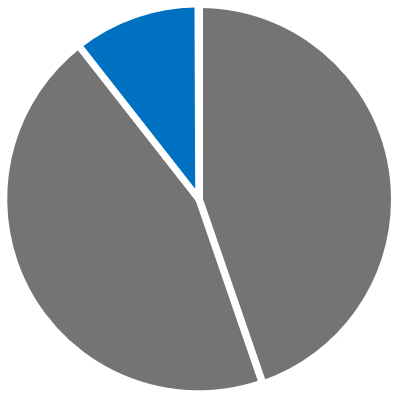 ~10% required 10–60 minutes of manual reprocessing, assignment, or structure elucidation
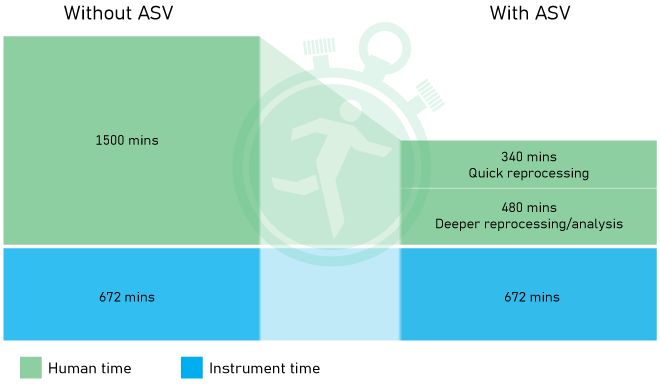
They also compared the time it took to manually analyze a batch of 96 samples with the time it took using ASV. They found that, even with approximately 10 minutes of manual data marshalling, using ASV cut down the amount of expert time required by almost a half.
They also noted that most of the samples in the 10% that required significant expert attention had the incorrect structure proposed. For these they chose to elucidate and verify the correct structure. However, they note that they could have saved even more time by simply disposing of those samples, as they were clearly not what they intended to have in their chemical store.
Future Potential of ASV at Syngenta
With this in mind, Katharina and her colleagues at Syngenta are currently considering other workflows that could benefit from the implementation of ASV. Combining the average time savings of 7 minutes/sample and the estimation of 20,000 samples they produce per year that could be analyzed with ASV, they potentially save 98 days/year on structure verification. As ASV continues to improve in the future, particularly as it evolves to handle more complicated verification tasks (e.g., samples containing rotameric and diastereomeric mixtures or NMR-invisible functional groups), the time savings will only grow.
Automated Structure Verification at Amgen
Tatiana and the rest of the Structural Chemistry Group at Amgen support the medicinal chemists by providing in-depth NMR characterization of small molecules and maintaining high-throughput NMR for structure characterization.
Amgen have been using the automated structure verification (ASV) capabilities of NMR Workbook Suite™ for many years, but the technological advancement of other components of their NMR workflows have recently underscored its value to Tatiana and her team.

Tatiana Didenko
Principal Scientist
Implementation of the Universal Database
In 2020, they implemented their Universal Database (UDB): a Spectrus database that acts as one location for all small molecule analytical data. It integrates LC/MS and NMR data from a variety of workflows and sources, including open access instruments. The database is integrated with their ELN and core registration workflows. The live analytical data can also be easily searched by anyone in the organization or used in AI/ML applications.
Because the data in the UDB can be so easily proliferated across the organization, the data and corresponding analyses it contains must be accurate and high-quality. Because of this new emphasis on data and analysis quality, they have found ASV particularly beneficial because it:
- Improves decision-making in structure verification while reducing errors in sample submission
- Provides more comprehensive proof of structure for samples being submitted for assays and to the Sample Bank
- Adds value by providing the chemists a better tool for characterizing newly synthesized compounds
High-Throughput NMR
Amgen also has a sophisticated high-throughput NMR (HTNMR) workflow in which every step is highly streamlined. The acquisition setup is initiated by simply scanning a barcode on the 96-well plate. This also imports all the metadata assembled in an SDfile. Samples are then delivered automatically to the instrument’s cyroflow cell. They use NMR supersequences to record multiple spectra at once and cut down on acquisition time.
To streamline the data analysis, they rely on batch ASV for automated processing and analysis. Tatiana notes that ASV generally provides accurate results for even large, complex structures using only 1D 1H and 1H-13C HSQC spectra, however they sometimes use 1H-1H COSY as well.
High-Throughput Quality Control Using ASV
Based on this workflow, Tatiana and her team can perform high-throughput quality control (HT-QC) for compounds in the sample bank or commercial/externally synthesized compound or libraries to:
- Confirm the structure
- Check material integrity
- Generate consistent NMR data for use in-house or in patents/publications
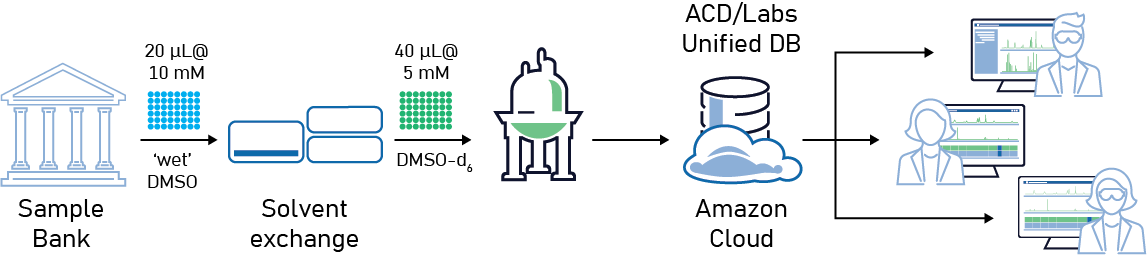
With this HT-QC workflow shown in Figure 1, Tatiana and her team can analyze up to 25 compounds per day, which works out to 5000 compounds in a year. For a 96-sample well plate, they can provide results in 5 business days. They add the analyzed data and results to the UDB, where it can be viewed and used by others in the organization, or employed in AI/ML applications.
Download the Amgen case study to read offline.