June 24, 2025
by Sherry Myles, Marketing Systems Coordinator, ACD/Labs
Evolving Chemical Nomenclature Through Continuous Innovation in ACD/Name
In chemistry, precision is paramount—and nowhere is this more evident than in the naming of chemical compounds. Like travelers plotting different routes to the same destination, chemists have long navigated a landscape of synonyms, trade names, and systematic nomenclature to describe molecules. Whether you call it fluoxetine, N-methyl-3-phenyl-3-[4-(trifluoromethyl)phenoxy]propan-1-amine, or Prozac, the compound remains the same. But which is the right name?
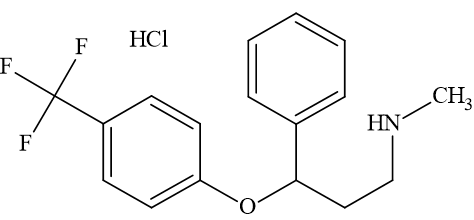
(±)-N-Methyl-3-phenyl-3-[(α,α,α-trifluoro-p-tolyl)oxy]propylamine Hydrochloride
(±)-N-Methyl-γ-[4-(trifluoromethyl)phenoxy]benzenepropanamine Hydrochloride
Fluoxetine Hydrochloride
N-Methyl-3-(p-trifluoromethylphenoxy)-3-phenylpropylamine Hydrochloride
Prozac [Lilly]
Figure 1: The structure of N-Methyl-3-(p-trifluoromethylphenoxy)-3-phenylpropylamine Hydrochloride with the preferred name in bold.
For years, the chemical community lacked consensus on the “most correct” name for a compound. That changed with the introduction of Preferred IUPAC Names (PINs) in the IUPAC “Blue Book” published in 2013. This update brought with it clarity and consistency, especially critical for patent filings, regulatory submissions, and scientific communication.
As naming conventions evolve to keep pace with new classes of compounds—like cyclophanes and cyclic peptides—the need for accurate, up-to-date nomenclature tools becomes more urgent. Chemical naming is no longer just about memory and manual application of rules. It’s a science supported by robust software, none more prominent than ACD/Name.
The Birth and Evolution of ACD/Name
Introduced in 1996, ACD/Name began as a basic English-language tool for organic nomenclature. Fast-forward to today, and it can generate names for organic, biochemical, and some inorganic structures in over 20 languages. Producing names algorithmically rather than from a database, it handles structures that have yet to be synthesized.
ACD/Name is built on a foundation of rigorous algorithm development, informed by decades of experience in both chemistry and software engineering. With every update, the software aligns with the latest IUPAC and CAS standards. Importantly, Name has been developed and maintained by the same project leader for over 30 years. Dr. Andrey Yerin has not only guided the software’s development, he actively collaborates with IUPAC committees to improve and refine chemical naming practices.
IUPAC vs. CAS: A Tale of Two Systems
IUPAC and CAS (Chemical Abstracts Service) nomenclatures share common roots but differ significantly in execution. IUPAC’s naming conventions are public, structured for clarity and uniqueness, and constantly evolving to meet scientific advancements. CAS, by contrast, generates proprietary Index names and maintains its massive Registry database with strict naming rules designed to ensure a single name per substance.
ACD/Name respects both systems. It can generate names adhering to IUPAC recommendations and closely approximates CAS Index names through proprietary algorithms, providing a powerful dual approach for professionals needing regulatory or academic precision.
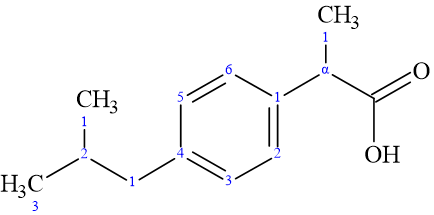
Preferred IUPAC Name: 2-[4-(2-methylpropyl)phenyl]propanoic acid
CAS Index Name: benzeneacetic acid, α-methyl-4-(2-methylpropyl)-
Figure 2: Structure of Ibuprofen. The Preferred IUPAC Name and CAS Index Name can both be produced in ACD/Name.
Why Keeping Software Updated Matters
In the continuously evolving arena of chemical nomenclature, even the experts can stumble without the latest tools. Recently, editors at Helvetica Chimica Acta—long-time users of ACD/Name—flagged a chemical name (Figure #) in a proposed document about ACD/Name. Upon consultation, we saw that the name was correct, but the Helvetica team hadn’t yet updated to the newest version of the software, which included critical changes to stereo configuration handling.
When the Helvetica team updated their software, it correctly named the compound in accordance with IUPAC’s revised rules for natural products and stereochemistry:
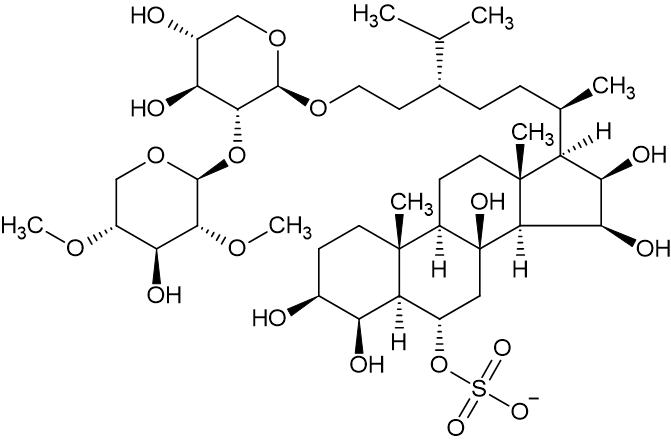
Correct Name:
sodium (24R)-29-{[2-O-(2,4-di-O-methyl-β-D-xylopyranosyl)-β-D-xylopyranosyl]oxy}-3β,4β,8,15β,16β-pentahydroxy-5α-stigmastan-6α-yl sulfate
vs.
Old Name:
sodium (3β,4β,5α,6α,15β,16β,24R)-29-{[2-O-(2,4-di-O-methyl-β-D-xylopyranosyl)-β-D-xylopyranosyl]oxy}-3,4,8,15,16-pentahydroxystigmastan-6-yl sulfate
Figure 3: An update to Name version ## improved naming of structures with stereo configuration, resulting in the changed names for the shown structure.
This served as a valuable lesson in the importance of keeping scientific tools current.
Beyond Just Naming…
In practice, chemical nomenclature software is no longer limited to assigning names—it also includes structure generation, registry matching, and data integration. ACD/Name supports reverse conversion from names to structures and integrates seamlessly with ACD/Dictionary, a reference database of over 170,000 names, registry numbers, and compound classes.
It was also among the first structure drawing tools to integrate the International Chemical Identifier (InChI) system. It offers full InChI-to-structure capabilities, including generation of InChIKeys, making ACD/Name not only relevant, but essential in today’s digital chemical landscape.
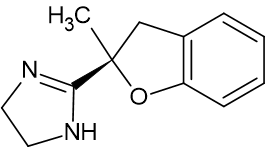
InChI: 1S/C12H14N2O/c1-12(11-13-6-7-14-11)8-9-4-2-3-5-10(9)15-12/h2-5H,6-8H2,1H3,(H,13,14)/t12-/m1/s1
InChI Key: FEGRMCYCYUYYDA-GFCCVEGCSA-N
Figure 4: InChI and InChIKey for 2-[(2R)-2-methyl-2,3-dihydro-1-benzofuran-2-yl]-4,5-dihydro-1H-imidazole.
ACD/Labs and the Future of Nomenclature
We recently celebrated the 30th anniversary of ACD/Labs and the beginning of the ACD/Name project. Over those decades, the software has matured into a sophisticated, indispensable tool relied on by researchers, regulatory specialists, IP lawyers, and students across the globe. Our ongoing collaboration with IUPAC ensures its continued relevance/significance in the future of chemical naming.
As noted in a 2006 Molecules article by Gernot Eller:
“When compared with other naming software…the quality of names generated from ACD/Name is second-to-none.”
G. Eller. (2006). Molecules, 11, 915–928.
https://www.mdpi.com/1420-3049/11/11/915
In a field where accuracy is not just helpful but vital, ACD/Name stands as the gold standard in chemical nomenclature.
About the Author