

April 30, 2026
by Mikhail Elyashberg, Leading Researcher, ACD/Labs
Computer-Assisted Elucidation of Cyathstrine A Using Structure Elucidator Suite
Natural products derived from fungi have long been regarded as rich sources of structurally diverse and biologically active compounds, many of which act as lead candidates in drug discovery. Within the basidiomycetes, bird’s nest fungi (family Nidulariaceae) stand out for their distinctive morphology and ecological roles, yet their chemical and pharmacological potential remains comparatively underexplored.
This group of fungi is notable for its characteristic bird’s nest–like fruiting bodies, which are not only visually remarkable in mycology but also represent a promising reservoir of diverse secondary metabolites. Although C. striatus has limited documentation in traditional medicine, recent research indicates that it functions as a biosynthetic “factory” for cyathane-type diterpenoids—natural compounds featuring a rare 5/6/7 tricyclic carbon framework.
The “One Strain–Many Compounds” (OSMAC) strategy has emerged as an effective method for enhancing fungal metabolite production by altering culture conditions and environmental parameters. Applying this approach to C. striatus provides valuable opportunities to uncover novel cyathane scaffolds and bioactive derivatives. Using OSMAC, researchers have isolated and identified 24 secondary metabolites, including 11 new erinacine-like cyathane diterpenoids and 13 previously known compounds [1].
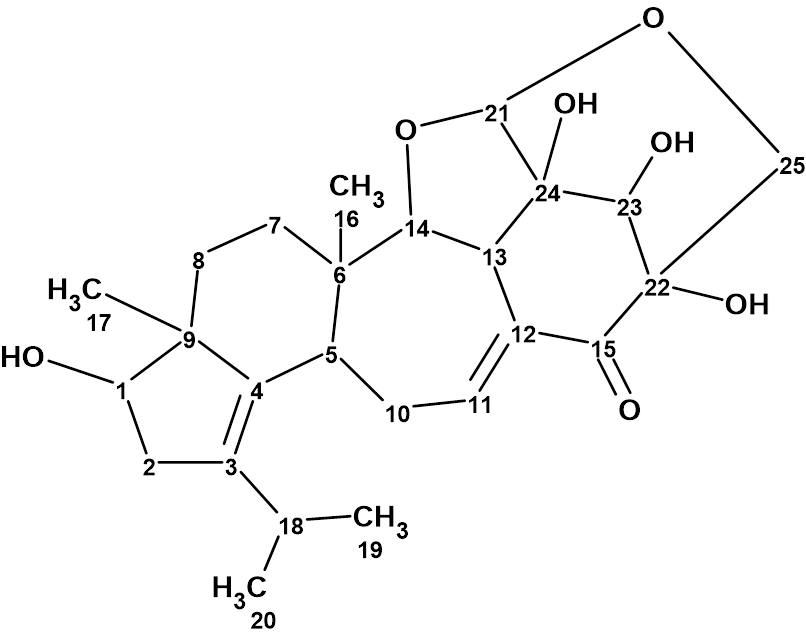
Among the new compounds, cyathstrine A (1), a polycyclic polyoxygenated cyathane diterpenoid, was isolated and identified using 1D and 2D NMR spectra. We used this information for challenging ACD/Structure Elucidator.
1
Cyathstrine A (1) was isolated as yellow oil. High-resolution electrospray ionization mass spectrometry (HR-ESI-MS) revealed the pseudomolecular ion peak at m/z 469.2198 [M+ Na]+, suggesting its molecular formula of C25H34O7 (calcd. for C25H34O7Na, 469.2197), which corresponded to nine degrees of unsaturation. The 1H and 13C spectroscopic data, as well as key HMBC and COSY correlations are presented in Table 1.
Table 1. 1D and key 2D spectroscopic data of Cyathstrine A [1].
| Label | δC | δC calc (HOSE) | XHn | δH | M (1H) | COSY | H to C HMBC |
| C 1 | 79.4 | 78.1 | CH | 3.89 | u | 2.66 | C 8, C 3 |
| C 2 | 38.5 | 37.87 | CH2 | 2.66 | u | 3.89 | C 4 |
| C 2 | 38.5 | 37.87 | CH2 | 2.23 | u | ||
| C 3 | 137.8 | 135.34 | C | ||||
| C 4 | 136.8 | 136.83 | C | ||||
| C 5 | 43.6 | 44.1 | CH | 2.96 | u | 2.93 | C 16, C 3 |
| C 6 | 43.2 | 42.81 | C | ||||
| C 7 | 27.4 | 26.24 | CH2 | 1.21 | u | ||
| C 7 | 27.4 | 26.24 | CH2 | 1.5 | u | 1.87 | |
| C 8 | 27.5 | 28.29 | CH2 | 1.87 | u | 1.5 | C 6 |
| C 9 | 53.5 | 51.89 | C | ||||
| C 10 | 32.8 | 34.15 | CH2 | 2.93 | u | 2.96, 6.61 | C 4, C 12 |
| C 10 | 32.8 | 34.15 | CH2 | 2.75 | u | ||
| C 11 | 140.9 | 145.1 | CH | 6.61 | u | 2.93 | C 5 |
| C 12 | 140.1 | 136.02 | C | ||||
| C 13 | 44.3 | 47.65 | CH | 3.42 | u | 4.15 | C 6, C 15 |
| C 14 | 96.9 | 89.75 | CH | 4.15 | d | 3.42 | C 12 |
| C 15 | 201 | 198.33 | C | ||||
| C 16 | 17.5 | 19.38 | CH3 | 0.99 | s | C 7, C 18, C 14, C 3 | |
| C 17 | 24.5 | 21.18 | CH3 | 1.1 | s | C 8, C 9, C 4 | |
| C 18 | 28.2 | 27.03 | CH | 2.87 | u | C 2, C 4 | |
| C 19 | 22.5 | 21.78 | CH3 | 0.99 | u | ||
| C 20 | 21.7 | 21.78 | CH3 | 1.01 | u | C 18, C 3 | |
| C 21 | 106.7 | 105.12 | CH | 5.17 | u | C 13, C 22, C 14 | |
| C 22 | 79.7 | 77.41 | C | ||||
| C 23 | 76.8 | 70.84 | CH | 4.07 | u | C 13, C 25, C 21 | |
| C 24 | 78.6 | 78.08 | C | ||||
| C 25 | 69.8 | 71.41 | CH2 | 3.6 | u | C 21, C 15 |
The molecular formula C25H34O7 and spectroscopic data displayed in Table 1 were entered into the program which created the Molecular Connectivity Diagram, MCD, shown in Figure 1.
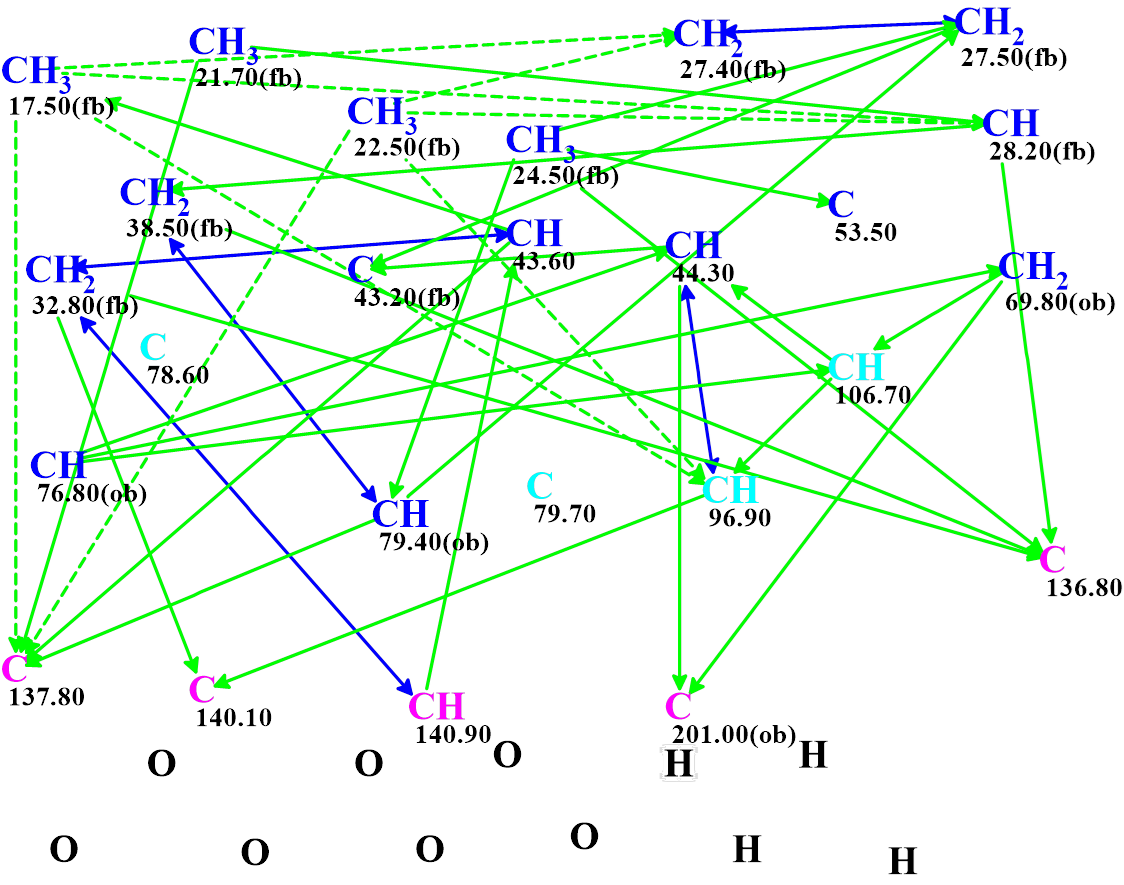
Figure 1. Molecular connectivity diagram (MCD) of Cyathstrine A. Hybridizations of carbon atoms are marked by corresponding colors: sp2 – violet, sp3 – blue, not sp – light blue. Labels “ob” and “fb” are set by the program to carbon atoms for which neighboring with heteroatom is either obligatory (ob) or forbidden (fb). HMBC connectivities are marked by green arrows, while COSY connectivities by blue arrows.
We see that the MCD contains four light blue carbon atoms (78.60, 79.70, 96.90 and 106.70 ppm) with ambiguous hybridization, two of which (78.60 and 79.70 ppm) have no connectivity. The presence of carbons of such kind usually leads to an increase in structure generation time.
Structure generation accompanied with 13C chemical shift prediction was initiated. As a result, only one structure was generated in 2 s (Figure 2).
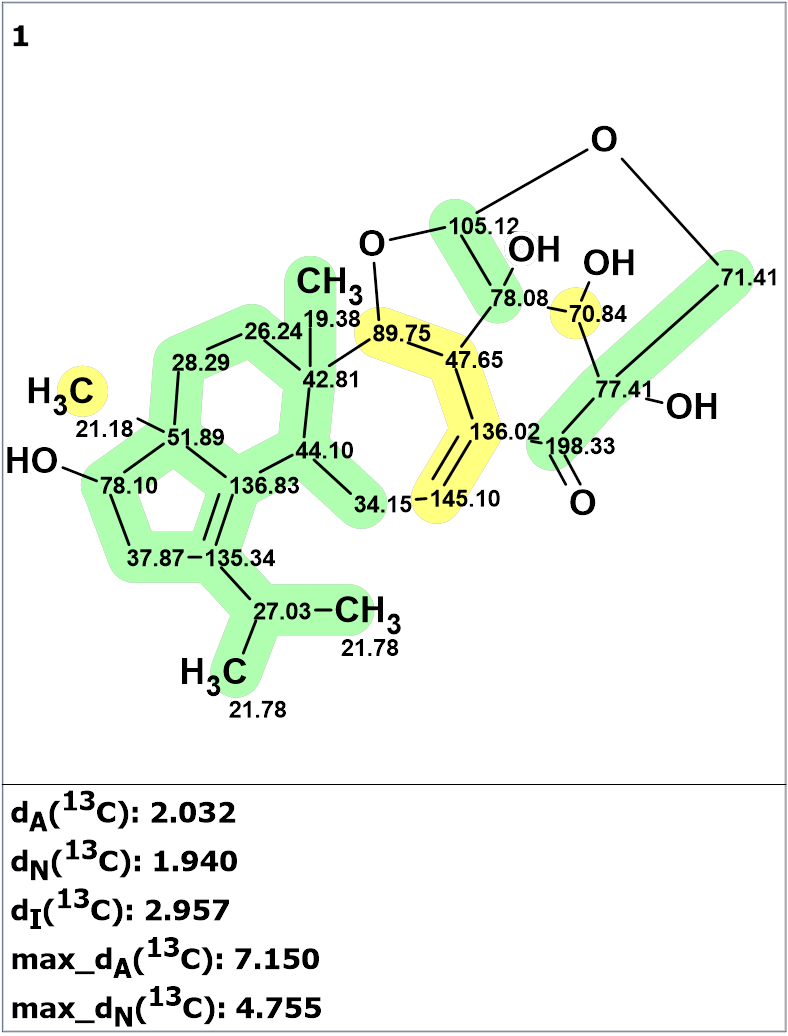
Figure 2. The generated structure. 13C chemical shift prediction was carried out using the HOSE code-based method, the neural networks, and the incremental approach. Average deviations of 13C chemical shifts determined by these methods are denoted as dA, dN and dI correspondingly. Each atom is colored to mark a difference between its experimental and calculated 13C chemical shifts. The green color represents a difference between 0 to 3 ppm, yellow was between 3 and 15 ppm and red more than 15 ppm.
Figure 2 shows that the generated structure is identical to that of Cyathrstrine A determined in [1].
As shown in the textbook [2], determining the structure of an unknown substance based on 1D and 2D NMR spectra is accomplished by deriving all possible values (structures) from a system of axioms linking the structure of the analyzed molecule to its spectral data. The solution to the problem typically contains a set of structures satisfying all axioms. This occurs when the system of axioms is true and consistent. If this system is also (in a certain sense) complete, that is, contains all the information specific to a given structure, then the generation leads to a single structure. This is quite rare, but it occurred in the case of Cyathstrine A.
Thus, the structure of a complex polycyclic natural product containing seven oxygen atoms was unambiguously determined using Structure Elucidator in a fully automatic mode almost instantly.
References
- C. Zhao, S. Zhao, D. Zhang, M. Stadler, C. Liu, Q.-Q. Shi, Y.-Q Gao, W.-Bo Han, and J.-M. Gao. (2025). Cyathstrines A–K, Structurally Diverse Polycyclic Polyoxygenated Cyathane Diterpenoid Xylosides with Antibacterial and Neuroprotective Activities from the Fungus Cyathus striatus. Journal of Natural Products, 88(12), 2909-2920, DOI: 10.1021/acs.jnatprod.5c01149
- M.E. Elyashberg, A.J. Williams. Computer-based Structure Elucidation from Spectral Data. The Art of Solving Problems. Springer, Heidelberg, 2015, 454 http://www.springer.com/978-3-662-46401-4
About the Author