

January 1, 2012
by Mikhail Elyashberg, Leading Researcher, ACD/Labs
α-botryoxanthin A
The Initial Challenge
Botryococcus braunii is a colonial green microalga that is known for producing various types of hydrocarbons and other types of oils. In a 1998 publication, Okada and co-workers1 isolated and identified two new carotenoids in their efforts to better understand the relationship between colony color and hydrocarbon production (color being a key element to distinguish different types of colonies).
The Evidence
- The molecular formula of α-botryoxanthin A was determined to be C74H112O2
- The following data were acquired:
- 1D 1H NMR and 13C NMR
- 2D 1H-1H COSY (4 correlations), 1H-13C HMBC (224 correlations)
The CASE (Computer Assisted Structure Elucidation) Investigation
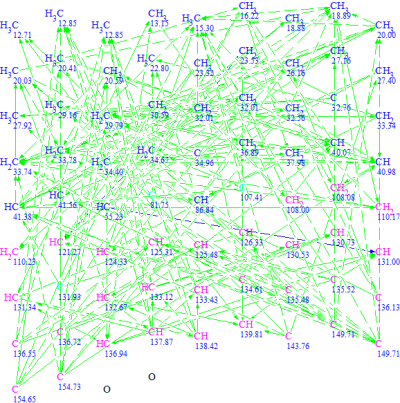
The Molecular Connectivity Diagram produced by Structure Elucidator
-
- ACD/Structure Elucidator produced a Molecular Connectivity Diagram (MCD) from the experimental data.
- A built-in algorithm, specifically designed to check the consistency of all the experimental data, reported one issue with a non-standard connectivity.
- The reported issues enabled the software to run the elucidation in Fuzzy Generation mode with parameters m=1 (the number of connectivities with non-standard lengths) and a=1 (the connectivity augmentation).2
- Applying all possible combinations of connectivities, the Fuzzy Generation mode generated two candidate structures in less than 6 hours. Structure 1 ranked in the first position based on the lower dA value; the average deviation (dA) is a comparison between the experimental and predicted chemical shifts.

-
- If the single NSC was corrected by hand, it was unnecessary to use the Fuzzy Generation mode, and the software generated a single structure in less than 1 second.
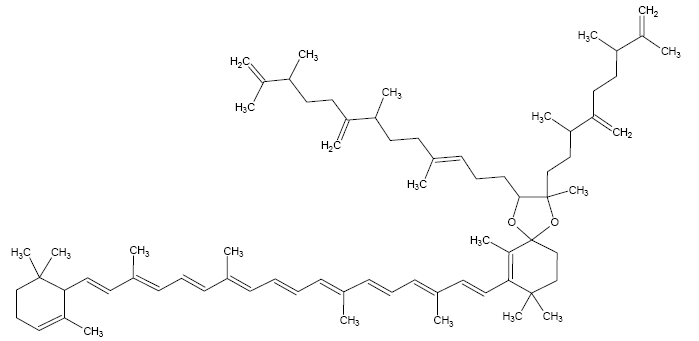
Structure 1
- Structure 1 matches the structure published by the original authors who solved it by traditional means.
Conclusions
For this example, Fuzzy Generation mode is successfully applied to solve for a large molecule (> 1000 Da) with a large number of NMR connectivities. The Fuzzy Generation mode offers the user the capability to automatically scrutinize NMR data and provide a solution which is not available with other CASE systems. ACD/Structure Elucidator is a complete elucidation package offering tools to speed up the elucidation process and ensure that no candidate is overlooked.
References
- S. Okada, I.Tonegawa, H. Matsuda, M.Murakami, K. Yamaguchi Phytochem., 47:1111–1115, 1998.
- Mikhail E. Elyashberg, Kirill A. Blinov, Sergey G. Molodtsov, Antony J. Williams, and Gary E. Martin J. Chem. Inf. Model., 47 (3):1053–1066, 2007.
About the Author